
Effects of land-surface characterizations on desert dust emissions
Mineral dust is by mass the dominant aerosol type in the atmosphere, and it influences weather by regulating the radiation and cloud budget. It is vital to accurately predict global and regional dust levels to understand its impacts on air pollution, radiation, clouds, and biogeochemistry. However, the physics of dust emission is not very complete in Earth system models (ESMs), hindering the accuracy of dust loading predictions in terms of spatiotemporal variability as well as the associated Earth system predictability.
Our studies focus on investigating how land-surface conditions (such as rocks and vegetation) as well as boundary-layer characteristics influence dust emission and transport. We developed a dust emission scheme that captures both impacts: The first one is the physics of wind drag partition due to surface roughness elements, such as vegetation and rocks, that can partition and absorb surface wind stress and reduces wind erosion on soils. Another physics is the dust emission intermittency due to high-frequency near-surface turbulence, primarily because turbulence-driven wind fluctuations can sweep across the dust emission threshold and shut off emissions multiple times within a model timestep, leading to the smaller dust fluxes than GCMs predicted. Our newly developed dust emission scheme shows very different global patterns of dust emissions and dust aerosol optical depth compared with the other dust emission schemes in the Community Earth System Model version 3 (CESM3). The Leung et al. (2023; L23) scheme is now the default dust emission scheme in CESM3, and is also used in other models such as GEOS-Chem as a default (Zhang et al., 2025).
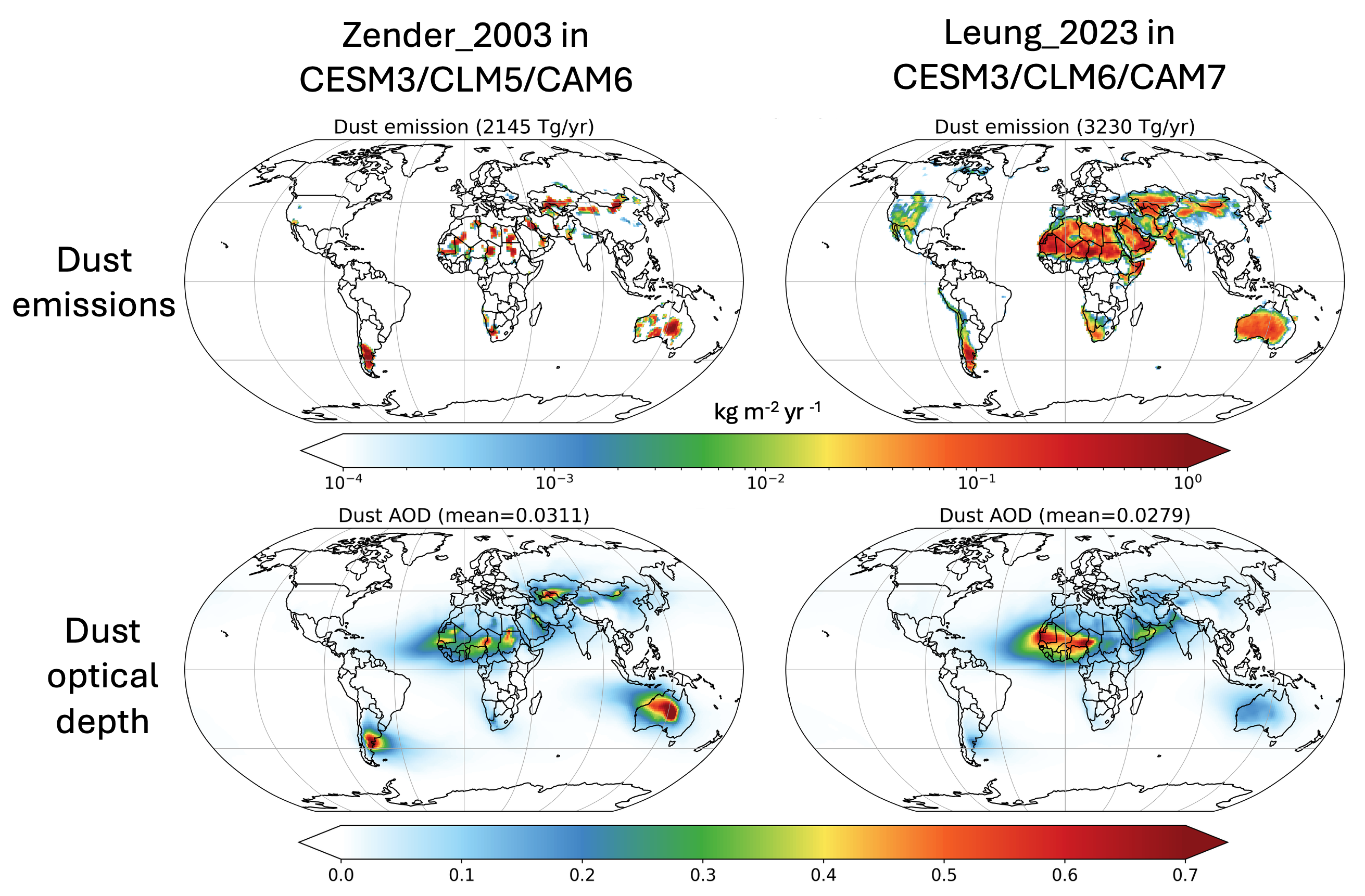
Leung_2023 (L23) is our newly developed dust emission scheme in the CESM3. It shows a very different spatial distribution than the older Zender et al. (2003) scheme. L23 has a more spatially homogeneous dust following the global distributions of deserts and the dust strength reasonably peaks in the Sahara. The extremely high dust peaks over Patagonia and Australia are now gone in L23.
References:
• Danny M. Leung et al., 2023, Atmos. Chem. Phys., 23, 6487-6523. [link]
• Danny M. Leung et al., 2024, Atmos. Chem. Phys., 24, 2287–2318. [link]
• Danny M. Leung, 2026, CLM Technical Note on dust emissions. [link]
• Dandan Zhang et al., 2025, Geosci. Model Dev., 18, 6767–6803. [link]
• Longlei Li et al., 2026, J. Adv. Model. Earth Syst., 18, e2025MS005420. [link]
Historical evolution of global and regional dust
Since dust is a globally dominant aerosol type and has cooling effects on Earth's atmosphere, it is important to understand its historical evolution in the atmosphere and answer the question of how dust historically influences the Earth's sensitivity to the greenhouse gases-induced warming. Long-term sedimentary and ice core records indicate that dust has historically increased by 50–55 % for 1850–2000. The issue is that the current Earth system models (ESMs) cannot accurately capture the historical increase in dust. This is bizzare, because the dust emission schemes in ESMs are dependent on meteorological conditions like winds and land-surface conditions like soil moisture and leaf area index. Historical simulations of meteorology and land state should be influencing simulated historical dust emissions and driving the increase in dust. Thus, what hinders our models from capturing the historical dust changes and how we can fix the models remain the pressing science questions to address. There are two hypotheses that need to be tested: (1) We may have historical biases in the land state, and (2) our dust emission scheme needs to couple better with the meteorology and the land.
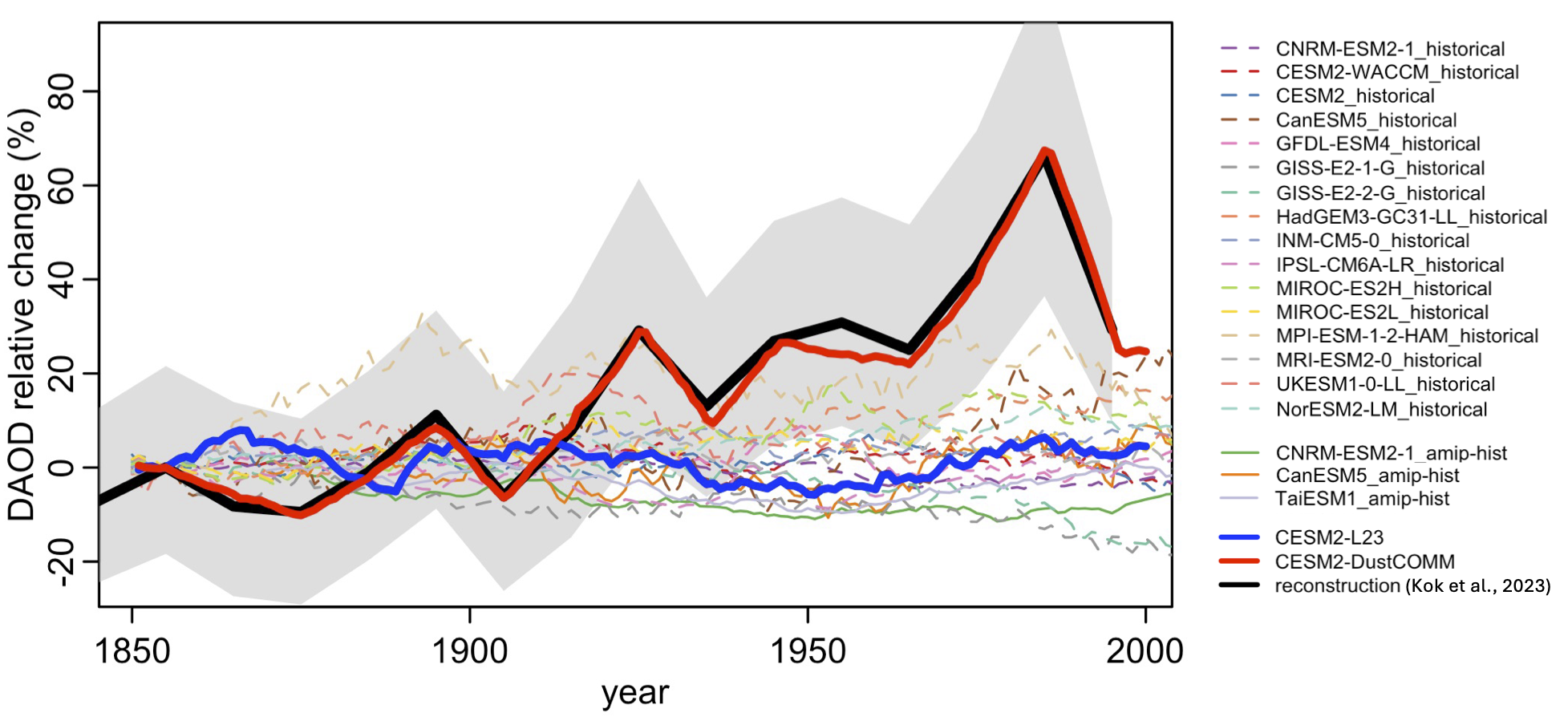
Historical (1850–2000) dust variability as depicted by a global dust reconstruction using multiple sites of sedimentary and ice core records of dust (black line), as well as by a suite of global Earth system model simulations (colored dashed and solid lines) from multiple Earth system models. All time series are 10-year running means of annual dust time series. Nearly no models can replicate the reconstructed historical dust increase. We used an empirical inversion method with the core records to derive a global dust emission dataset (DustCOMM) for 1850–2000. We then used DustCOMM emissions to drive the Community Earth System Model simulation (red solid line). This is the only simulation that empirically captures the historical variability of dust. Reprinted from Atmospheric Chemistry and Physics, Vol. 5, Issue 24, Leung, D. M. et al., “A global dust emission dataset for estimating dust radiative forcings in climate models”, pp. 2311–2331. Danny M. Leung retains the figure’s copyright in this paper published by Copernicus Publications under the Creative Commons Attribution 4.0 License (CC BY 4.0).
References:
• Jasper F. Kok et al., 2023, Nature Rev. Earth & Environ., 4, 71-86. [link]
• Danny M. Leung et al., 2025, Atmos. Chem. Phys., 25, 2311–2331. [link]
Effects of meteorology and long-term weather on air quality
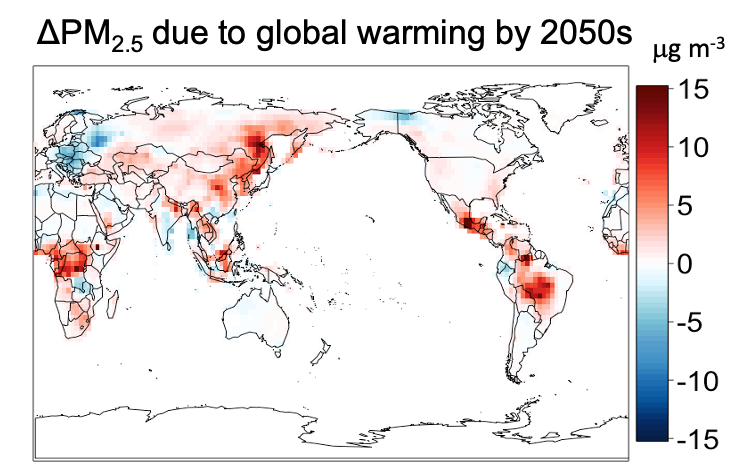 Global PM2.5 changes by 2050s due to temperature change, estimated from our statistical model. Many regions have higher PM2.5 levels because of higher temperature, leading to faster chemistry, higher biogenic emissions and more fires in the future. Some regions have decreased PM levels because of the volatilization of nitrate and organics under higher temperature.
The variability of air quality is determined by both changes in emissions and meteorology. I investigate how day-to-day changes in local meteorology (e.g., temperature, humidity, rainfall, wind direction) as well as synoptic circulation (e.g., cyclones, monsoons, highs), will impact on global and East Asian air quality, with a focus on fine particulate matter (PM2.5). To achieve this, we use coupled chemistry–meteorology modeling (e.g., GEOS-Chem, CESM) and multivariate statistical analysis of global observations to examine the importance of meteorology on PM2.5. For example, we showed that over much of East Asia, air quality is determined by the northerly cold advections from the semi-permanent Siberian High as quantified by the principal component analysis (PCA). Our study also shows that the interannual variability of PM2.5 is mostly driven by interannual temperature changes. It follows that global warming will exacerbate future PM2.5 air quality over most of the world. We constructed a statistical model to predict future PM2.5 changes by 2050s due to meteorological changes, and our predictions indicate some increase in PM2.5 up to ~30 μg m-3. We showed that this "climate penalty" effect will partially counteract the air quality improvements by anthropogenic emissions reductions.
References:
• Danny M. Leung et al., 2018, Atmos. Chem. Phys., 18, 6733-6748. [link]
Effects of human emissions reductions on air quality in East Asia
Anthropogenic emissions are major sources of PM2.5 and ozone air pollution. In recent years, countries have been curtailing emissions to alleviate air pollution. However, pollutant levels have been dropping in smaller rates (in % yr-1) compared with the rates of emissions reductions, and scientists discover that atmospheric chemistry constitutes several negative feedback mechanisms that lead to retarded air quality improvements. Our study show two chemical mechanisms that hinder air quality improvements over metropolitan regions. First, city clusters with high nitrogen oxides (NOx) level will render ozone production more volatile organic compound (VOC)-limited; under this ozone production regime, NOx emissions reductions enhance both hydroxyl (OH) radical and ozone levels, increasing atmospheric oxidation capacity (AOC) that accelerates secondary PM2.5 formation. Second, ammonia (NH3) preferentially reacts with sulfur dioxide (SO2) over NOx especially over city clusters with SO2:NH3 >> 1. SO2 emissions reductions increase the atmospheric NH3 abundance which lead more NOx to react with NH3, producing more nitrate. Our study shows that these two mechanism are important for the recent buffered PM2.5 decrease especially in the wintertime when SO2:NH3 >> 1 and VOC-limited ozone chemistry are present. The Governments should enact more sophisticated policies to simultaneously curtail emissions and circumvent these negative feedbacks.
References:
• Danny M. Leung et al., 2020, Geophys. Res. Lett., 47(14), e2020GL087721. [link]
Publication list
1. Leung, D. M., A. P. K. Tai, L. J. Mickley, J. M. Moch, A. van Donkelaar, L. L. Shen, and R. V. Martin (2018). Synoptic meteorological modes of variability for fine particulate matter (PM2.5) air quality in major metropolitan regions of China, Atmos. Chem. Phys., https://doi.org/10.5194/acp-18-6733-2018
2. Leung, D. M., H. Shi, B. Zhao, J. Wang, E. M. Ding, Y. Gu, G. Chen, K. N. Liou, H. Zheng, S. Wang, J. D. Fast, G. Zheng, J. Jiang, X. Li, and J. H. Jiang (2020). Wintertime particulate matter decrease buffered by chemical mechanisms despite emissions reductions in China, Geophys. Res. Lett., https://doi.org/10.1029/2020GL087721
3. Kok, J. F., A. A. Adebiyi, S. Albani, Y. Balkanski, R. Checa-Garcia, M. Chin, P. R. Colarco, D. S. Hamilton, Y. Huang, A. Ito, M. Klose, D. M. Leung, L. Li, N. M. Mahowald, R. L. Miller, V. Obiso, C. Pérez García-Pando, A. Rocha-Lima, J. S. Wan, and C. A. Whicker (2021). Improved representation of the global dust cycle using observational constraints on dust properties and abundance, Atmos. Chem. Phys., https://doi.org/10.5194/acp-21-8127-2021.
4. Li, L., N. M. Mahowald, J. F. Kok, X. Liu, M. Wu, D. M. Leung, D. S. Hamilton, L. Emmons, Y. Huang, J. Meng, N. Sexton, and Jessica Wan (2022). Importance of different parameterization changes for the updated dust cycle modelling in the Community Atmosphere Model (version 6.1), Geosci. Model Dev., https://doi.org/10.5194/gmd-15-8181-2022.
5. Meng, J., Y. Huang, D. M. Leung, L. Li, A. A. Adebiyi, C. L. Ryder, N. M. Mahowald, and J. F. Kok (2022). Improved parameterization for emitted dust aerosols reduces model underestimation of super coarse desert dust, Geophys. Res. Lett., https://doi.org/10.1029/2021GL097287.
6. Kok, J. F., T. Storelvmo, V. A. Karydis, A. A. Adebiyi, N. M. Mahowald, A. T. Evan, C. He and D. M. Leung (2023). The impacts of mineral dust aerosols on global climate and climate change, Nat. Rev. Earth Environ., https://doi.org/10.1038/s43017-022-00379-5.
7. Leung, D. M., J. F. Kok, L. Li, G. S. Okin, C. Prigent, M. Klose, C. P. García-Pando, L. Menut, N. M. Mahowald, D. M. Lawrence, and M. Chamecki (2023). A new process-based and scale-aware desert dust emission scheme for global climate models – Part I: Description and evaluation against inverse modeling emissions, Atmos. Chem. Phys., https://doi.org/10.5194/acp-23-6487-2023.
8. Leung, D. M., J. F. Kok, L. Li, N. M. Mahowald, D. M. Lawrence, S. Tilmes, E. Kluzek, M. Klose, and C. P. García-Pando (2024). A new process-based and scale-aware desert dust emission scheme for global climate models – Part II: Evaluation in the Community Earth System Model (CESM2), Atmos. Chem. Phys., https://doi.org/10.5194/acp-24-2287-2024.
9. Leung, D. M., J. F. Kok, L. Li, D. M. Lawrence, N. M. Mahowald, S. Tilmes, and E. Kluzek, (2025), A global dust emission dataset for estimating dust radiative forcings in climate models, Atmos. Chem. Phys., https://doi.org/10.5194/acp-25-2311-2025.
10. Tang, W., R. Kumar, A. Del Moral Mendez, F. Ahafianyo, A. Akinsanola, …, P. Lawrence, D. Leung, S. Minallah, …, and P. Levelt (2025), The UCAR Africa Initiative: Recent insights, challenges, and opportunities to foster collaborative research for environmental sustainability, Bull. Am. Meterol. Soc., https://journals.ametsoc.org/view/journals/bams/aop/BAMS-D-24-0118.1/BAMS-D-24-0118.1.xml.
11. Zhang, D., R. V. Martin, X. Liu, A. van Donkelaar, C. R. Oxford, Y. Li, J. Meng, D. M. Leung, J. F. Kok, L. Li, H. Zhu, J. R. Turner, Y. Yan, M. Brauer, Y. Rudich, and E. Windwer (2025), Improving Fine Mineral Dust Representation from the Surface to the Column in GEOS-Chem 14.4. 1, Geosci. Model Dev., https://gmd.copernicus.org/articles/18/6767/2025/.
12. Li, L., N. M. Mahowald, X. Liu, M. G. Ageitos, Z. Ke, D. M. Leung, C. P. García-Pando, R. L. Miller, V. Obiso, P. Ginoux, J. F. Kok, …, and A. A. Adebiyi (2025), Modeling Large Dust Aerosols in the Community Earth System Model Version 2 (CESM2), in review on J. Adv. Model Earth Syst., https://eartharxiv.org/repository/view/9942/ (preprint).
13. Li, L., N. M. Mahowald, V. Obiso, J. F. Kok, R. L. Miller, X. Liu, M. G. Ageitos, C. P. García-Pando, D. M. Leung, …, and R. O. Green (2025), Dust Direct Radiative Effect Including Large Particles and Component Minerals, in review on Geophys. Res. Lett.
14. Ying, T., D. M. Leung, Falko Judt, Jasper F. Kok, Luke Fairbanks, and Amato T. Evan (2025), Resolving convection doubles Sahel's contribution to global dust emission during the monsoon season, in review on Geophys. Res. Lett.